

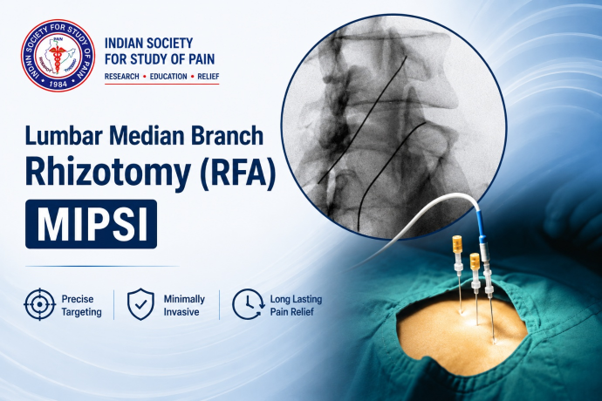
Chronic low back pain is one of the most common causes of disability worldwide. While many people associate back pain with slipped discs, a significant number of patients actually suffer from pain originating from the facet joints, the small joints that connect the vertebrae of the spine.
When medications, physiotherapy, and lifestyle modifications fail to provide lasting relief, a specialized image-guided procedure known as Lumbar Medial Branch Rhizotomy (RFA) MIPSI may offer significant improvement.
What is Lumbar Medial Branch Rhizotomy (RFA) MIPSI?
MIPSI stands for Minimally Invasive Pain and Spine Intervention.
The term has been introduced and promoted by the Indian Society for Study of Pain (ISSP) to better describe modern image-guided pain procedures. Rather than referring to these treatments as “pain injections” or “blocks,” the term MIPSI reflects their precision, scientific basis, and minimally invasive nature.
Lumbar Medial Branch Rhizotomy, also known as Radiofrequency Ablation (RFA), is an image-guided procedure that uses controlled radiofrequency energy to interrupt pain signals transmitted by the medial branch nerves supplying the painful facet joints.
The goal is to provide longer-lasting pain relief, improve function, and reduce dependence on medications without surgery.
Who May Benefit from Lumbar Medial Branch Rhizotomy (RFA) MIPSI?
This procedure is commonly recommended for patients suffering from:
Patients often describe symptoms such as:
When conservative treatment fails to provide adequate relief, Lumbar Medial Branch Rhizotomy (RFA) MIPSI may be considered as part of a comprehensive pain management plan.
How Does the Procedure Work?
Facet joints can become painful due to age-related degeneration, arthritis, repetitive stress, or previous spinal injuries.
The pain signals from these joints travel through small nerves called medial branch nerves.
During Lumbar Medial Branch Rhizotomy (RFA) MIPSI:
Since the nerve is targeted precisely under image guidance, surrounding structures are preserved while pain transmission is reduced.
Why Precision Matters
Not all causes of low back pain are the same.
Lumbar Medial Branch Rhizotomy (RFA) specifically targets pain arising from the facet joints. Prior diagnostic testing helps identify suitable candidates and improves treatment accuracy.
Image guidance allows the Pain Physician to precisely position the radiofrequency needle and maximize procedural effectiveness while minimizing risks.
Benefits of Lumbar Medial Branch Rhizotomy (RFA) MIPSI
Many patients experience meaningful improvements following the procedure.
Long-Lasting Pain Relief
Unlike temporary pain relief from medications, RFA may provide relief lasting several months or longer in appropriately selected patients.
Improved Physical Function
Reduced pain often enables patients to walk, exercise, and perform daily activities more comfortably.
Reduced Dependence on Medications
Many patients can reduce their use of pain medications under medical supervision.
Enhanced Participation in Rehabilitation
Pain relief allows patients to participate more effectively in physiotherapy and strengthening programs.
Minimally Invasive Alternative to Surgery
For patients with facet-mediated pain, RFA offers a non-surgical treatment option with minimal recovery time.
Is Lumbar Medial Branch Rhizotomy (RFA) MIPSI a Surgery?
No.
Lumbar Medial Branch Rhizotomy (RFA) MIPSI is a minimally invasive procedure and not a surgical operation.
There are no large incisions, no implants, and no prolonged hospital stay. Most patients return home on the same day after a short observation period.
What Results Can Patients Expect?
Every patient is unique, and outcomes depend on factors such as:
- Accurate diagnosis
- Severity of facet joint degeneration
- Duration of symptoms
- Overall health condition
- Adherence to rehabilitation recommendations
Many patients experience significant improvement in pain and function following the procedure.
It is important to understand that Lumbar Medial Branch Rhizotomy (RFA) MIPSI is not intended to be a standalone treatment. The best results are usually achieved when combined with:
- Physiotherapy
- Core strengthening exercises
- Posture correction
- Weight management
- Lifestyle modifications
The ultimate goal is not merely pain reduction but restoration of mobility, function, and quality of life.
FAQ
Final Thoughts
Living with chronic low back pain can affect every aspect of daily life. Fortunately, advances in Pain Medicine have provided effective non-surgical treatment options for carefully selected patients.
Lumbar Medial Branch Rhizotomy (RFA) MIPSI represents a precise, minimally invasive approach that targets the nerves responsible for transmitting facet joint pain. By reducing pain and improving function, it can help patients regain mobility and return to a more active lifestyle.
When performed by trained Pain Physicians under image guidance, it can play an important role in a comprehensive treatment strategy for chronic facet-mediated low back pain.
ISSP Awareness Message
Suffering from chronic pain? Visit a Pain Physician.
An initiative of the Indian Society for Study of Pain (ISSP).
To learn more about Pain Medicine and locate qualified Pain Physicians, visit the official ISSP website.
Find a Pain Physician Near You ( www.issp-pain.org)
About the Author
Dr. Debjyoti Dutta is a leading Pain Physician and educator in Pain Medicine. He serves as the Vice President of the Indian Society for Study of Pain (ISSP). With extensive experience in image-guided pain interventions and chronic pain management, he is actively involved in pain education, physician training, and promoting awareness about modern Pain Medicine across India.