

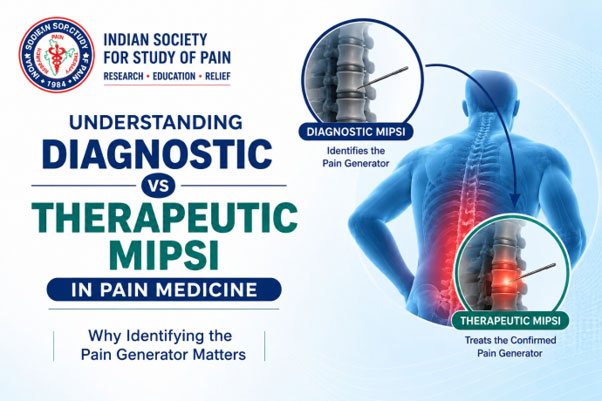
Understanding Diagnostic vs Therapeutic MIPSI in Pain Medicine: Why Identifying the Pain Generator Matters
Introduction
Pain Medicine has evolved tremendously over the past few decades. Modern image-guided interventions are no longer simply “pain injections” or “nerve blocks.” They are precise, evidence-based procedures performed to diagnose and treat the underlying source of pain using advanced imaging techniques.
To better represent this modern approach, the Indian Society for Study of Pain (ISSP) introduced the term Minimally Invasive Pain and Spine Intervention (MIPSI).
However, not all MIPSIs have the same purpose.
Some procedures are performed to identify the pain generator, while others are intended to treat the confirmed pain generator.
Understanding this distinction is essential for patients, referring physicians, and healthcare professionals because it forms the foundation of modern Pain Medicine.
Why Identifying the Pain Generator Matters
One of the greatest challenges in Pain Medicine is identifying which anatomical structure is actually responsible for the patient’s pain.
A patient may have:
- Disc bulges
- Facet joint arthritis
- Degenerative spinal changes
- Sacroiliac joint degeneration
- Foraminal narrowing
on MRI, yet only one—or sometimes more than one—of these structures may actually be producing pain.
Imaging studies such as MRI, CT scan, and X-rays are excellent for demonstrating structural abnormalities. However, they cannot independently determine whether those abnormalities are responsible for the patient’s symptoms.
For example:
- Many people have lumbar disc prolapse without back or leg pain.
- Facet joint arthritis may be seen in asymptomatic individuals.
- Degenerative changes increase with age and do not always correlate with pain severity.
This is where Diagnostic MIPSI plays a vital role.
What is Diagnostic MIPSI?
A Diagnostic MIPSI is a Minimally Invasive Pain and Spine Intervention performed primarily to identify or confirm the pain generator rather than to provide definitive treatment as the main objective.
The objective is to answer one critical clinical question:
“What is the pain generator?”
Depending on the suspected condition, Diagnostic MIPSIs may involve:
- Local anaesthetic-based diagnostic interventions
- Pain Provocative diagnostic procedures. (e.g. – Provocative Discography)
- Other image-guided techniques designed to confirm the source of pain
The results help Pain Physicians make more informed treatment decisions and select the most appropriate therapeutic intervention.
Examples of Diagnostic MIPSI
Common examples include:
- Diagnostic Lumbar Medial Branch MIPSI
- Diagnostic Cervical Medial Branch MIPSI
- Diagnostic Sacroiliac Joint MIPSI
- Diagnostic Selective Nerve Root MIPSI
- Lumbar Provocative Discography
Each procedure has a specific purpose, but all share one common objective—to identify or confirm the pain generator.
For instance, a Diagnostic Lumbar Medial Branch MIPSI using local anaesthetic temporarily interrupts pain transmission from the medial branch nerves. Significant relief of the patient’s typical pain during the expected duration of the local anaesthetic supports the diagnosis of facet-mediated pain.
Similarly, Lumbar Provocative Discography is performed not to relieve pain but to determine whether a particular intervertebral disc reproduces the patient’s characteristic symptoms and is therefore likely to be the pain generator.
What is Therapeutic MIPSI?
A Therapeutic MIPSI is performed with the primary objective of providing meaningful and sustained pain relief after appropriate clinical evaluation and patient selection.
Rather than identifying the pain generator, Therapeutic MIPSIs are designed to treat it.
Depending on the underlying condition, treatment may include:
- Radiofrequency Ablation (Rhizotomy) Therapeutic MIPSI
- Corticosteroid administration as Therapeutic MIPSI
- Regenerative Therapeutic MIPSI
- Neurolytic Therapeutic MIPSIs (e.g. Coeliac Plexus)
- Endoscopic spine Therapeutic MIPSI
- Other evidence-based image-guided Therapeutic MIPSI
The goal is to reduce pain, improve function, facilitate rehabilitation, and enhance quality of life while avoiding or delaying more invasive surgical procedures whenever appropriate.
Diagnostic MIPSI vs Therapeutic MIPSI
| Diagnostic MIPSI | Therapeutic MIPSI |
|---|---|
| Identifies or confirms the pain generator | Treats the confirmed pain generator |
| Primarily diagnostic | Primarily therapeutic |
| Guides treatment planning | Provides pain relief and functional improvement |
| Helps select appropriate patients | Helps restore mobility and quality of life |
| Usually temporary in purpose | Intended for sustained clinical benefit |
The difference lies not in the needle, medication, or imaging modality, but in the objective of the intervention.
Common Clinical Examples
| Suspected Pain Generator | Diagnostic MIPSI | Therapeutic MIPSI |
|---|---|---|
| Lumbar facet joint | Diagnostic Lumbar Medial Branch MIPSI | Lumbar Medial Branch Rhizotomy (RFA) MIPSI or Therapeutic Facet Joint MIPSI |
| Cervical facet joint | Diagnostic Cervical Medial Branch MIPSI | Cervical Medial Branch Rhizotomy (RFA) MIPSI |
| Sacroiliac joint | Diagnostic Sacroiliac Joint MIPSI | Therapeutic Sacroiliac Joint MIPSI |
| Discogenic pain | Lumbar Provocative Discography | Intradiscal Therapeutic MIPSI (where indicated) |
| Lumbar radicular pain | Diagnostic Selective Nerve Root MIPSI | Therapeutic Selective Nerve Root MIPSI or Spine Endoscopic MIPSI in appropriately selected patients |
Is a Diagnostic MIPSI Always Required?
No.
Whether a Diagnostic MIPSI is required depends on the individual patient’s clinical presentation.
When the source of pain is uncertain or multiple structures may be responsible, Diagnostic MIPSI can help confirm the pain generator before definitive treatment.
However, there are many situations where a Therapeutic MIPSI may be performed directly.
Examples include:
- Lumbar radicular pain with clear clinical and imaging correlation
- Other conditions in which the diagnosis is clinically evident
The decision is based on clinical judgment, available scientific evidence, and the individual patient’s condition.
Clinical Case 1 – Facet-Mediated Low Back Pain
A 65-year-old man presents with chronic low back pain that worsens on standing, walking, and spinal extension.
MRI demonstrates multilevel degenerative disc disease together with lumbar facet arthropathy.
Which structure is responsible for his pain?
Rather than assuming the MRI findings represent the pain generator, a Diagnostic Lumbar Medial Branch MIPSI is performed using local anaesthetic.
The patient experiences complete relief of his characteristic pain during the expected duration of the local anaesthetic.
The facet joints are therefore confirmed as the pain generator.
He subsequently undergoes Lumbar Medial Branch Rhizotomy (RFA) Therapeutic MIPSI and achieves sustained improvement in pain and function.
Clinical Case 2 – Lumbar Disc Herniation
A 42-year-old patient presents with severe radiating leg pain.
MRI reveals disc prolapse at both L4–L5 and L5–S1.
Which level is actually producing the symptoms?
A Diagnostic Selective Nerve Root MIPSI is performed to identify the symptomatic nerve root.
After confirmation, the patient undergoes a targeted Spine Endoscopic MIPSI to treat the underlying pathology.
The diagnostic intervention guides definitive treatment and avoids unnecessary intervention at the wrong spinal level.
Why ISSP Promotes the Terms Diagnostic MIPSI and Therapeutic MIPSI
Traditional terms such as:
- Pain injection
- Diagnostic block
- Therapeutic block
do not accurately reflect modern Pain Medicine.
Today’s image-guided interventions are precise, evidence-based procedures performed by trained Pain Physicians using fluoroscopy, ultrasound, CT guidance, or endoscopic techniques.
The terminology Diagnostic MIPSI and Therapeutic MIPSI more accurately describes:
- The objective of the procedure
- The precision of image guidance
- The scientific basis of patient selection
- The evolution of Pain Medicine as a distinct specialty
By promoting standardized terminology, ISSP aims to improve awareness among patients, healthcare professionals, and policymakers regarding the modern practice of Pain Medicine.
Message from ISSP Leadership
Dr. Sanjay Khanna
President, Indian Society for Study of Pain (ISSP)
Pain Physician, Jabalpur
“Imaging reveals anatomy—but not always the cause of pain. This article fills an important gap by helping patients understand how Pain Medicine uses Diagnostic MIPSI to identify the true pain generator. In Pain Medicine, the key to successful treatment is finding the right pain generator, not just the right image.”
Dr. Anurag Agarwal
Honorary Secretary, Indian Society for Study of Pain (ISSP)
Professor & Head, Department of Pain Medicine, Dr. Ram Manohar Lohia Institute of Medical Sciences (RMLIMS), Lucknow
“Pain Medicine stands as the only medical specialty dedicated exclusively to the comprehensive management of chronic pain syndromes. We anticipate that its significance in addressing chronic pain and spine disorders will soon parallel that of Cardiology in the management of heart disease. India is well positioned to emerge as a global leader in this rapidly evolving specialty. The adoption of standardized terminology such as Diagnostic MIPSI and Therapeutic MIPSI represents another important step toward advancing precision, education, and excellence in Pain Medicine.”
Final Thoughts
Modern Pain Medicine is not simply about giving injections.
It is about identifying the pain generator, selecting the right patient, choosing the appropriate image-guided intervention, and improving function while minimizing unnecessary procedures.
Diagnostic MIPSI and Therapeutic MIPSI represent two complementary components of this precision-based approach.
While Diagnostic MIPSI helps identify the source of pain when required, Therapeutic MIPSI provides targeted treatment based on sound clinical reasoning and evidence-based practice.
Together, they form the cornerstone of contemporary image-guided Pain Medicine and support better outcomes for patients suffering from acute and chronic pain.
ISSP Awareness Message
Suffering from Chronic pain? Consult a Pain Physician.
Modern Pain Medicine offers precise, image-guided Minimally Invasive Pain and Spine Interventions (MIPSIs) that help identify the pain generator and deliver targeted treatment when appropriate.
An awareness initiative by the Indian Society for Study of Pain (ISSP).